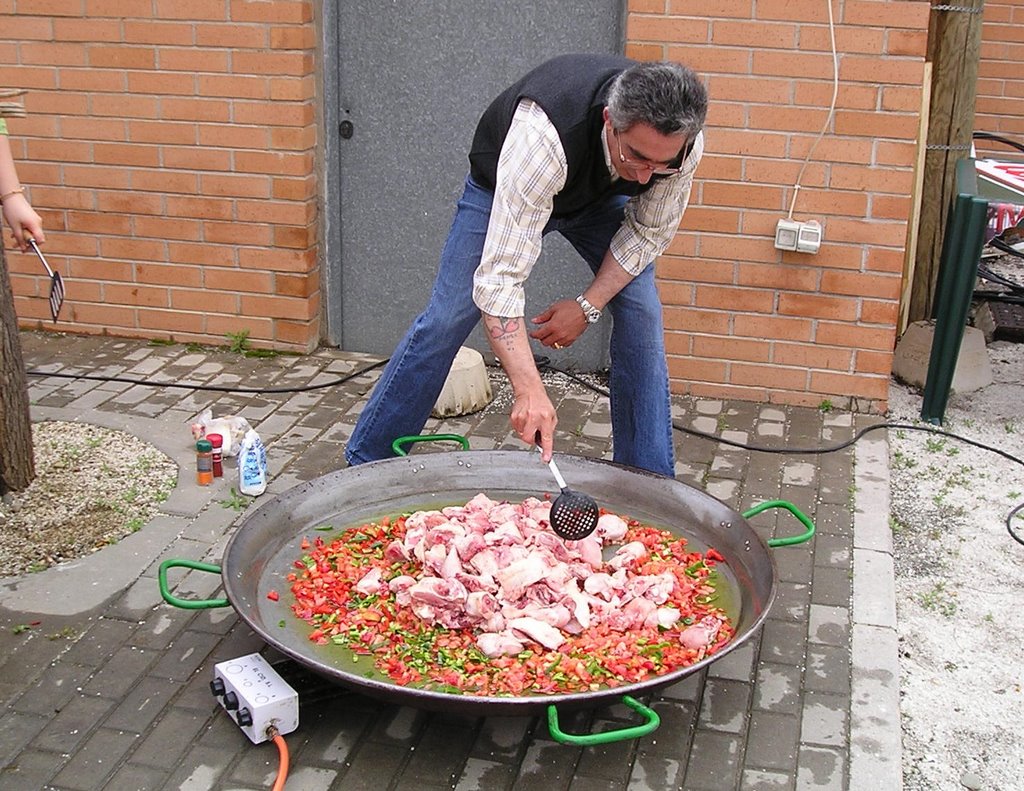
 Last week was cultural week at the dorm so management organized some interesting activities (sports, concerts, plays, etc.) among them the cooking (and feasting on) of the giant paella that you see on the picture. It's the Spanish way of celebrating something in their community, just like the Filipino tradition of roasting an entire adult pig usually during town festivals and the like. You think this paella is big? Well...it is actually smaller than the one I saw before in Intramuros, Manila during one of the cultural events organized by the Instituto Cervantes. That must have been 1.5 or twice the size of this paella! Oh well, I did not really get to taste this mouth-watering dish because I was too busy with thesis work (read: nerd). Manolo said they were selling it at 50 cents a plate! (photo taken by balate)
viernes, abril 28, 2006
GIANT PAELLA!!!
Last week was cultural week at the dorm so management organized some interesting activities (sports, concerts, plays, etc.) among them the cooking (and feasting on) of the giant paella that you see on the picture. It's the Spanish way of celebrating something in their community, just like the Filipino tradition of roasting an entire adult pig usually during town festivals and the like. You think this paella is big? Well...it is actually smaller than the one I saw before in Intramuros, Manila during one of the cultural events organized by the Instituto Cervantes. That must have been 1.5 or twice the size of this paella! Oh well, I did not really get to taste this mouth-watering dish because I was too busy with thesis work (read: nerd). Manolo said they were selling it at 50 cents a plate! (photo taken by balate)

lunes, abril 24, 2006
A Fil-Korean Wedding
 Last April 16 was the wedding day of Cathy and Jay which was celebrated in Changwon, the groom's hometown in South Korea. Cathy was one of my fellow delegates when I traveled to Japan in 1999 for a sponsored cultural tour in which we met Jay who was representing his country. Now whenever I think of their wedding, only one thought enters my mind: oh myy, time flies! Why? Because then we were just a bunch of university kids put together by a wealthy airline to offer us our first taste of Japan, but now it seems that everybody from that group is getting married! What a pity I couldn't go :--( I would have witnessed a good friend's wedding as well as catch up with some of our friends from that 1999 tour (group pic above). Not to mention I miss Korean food, too! (thanks Debs for the pics!)


viernes, abril 14, 2006
Semana Santa
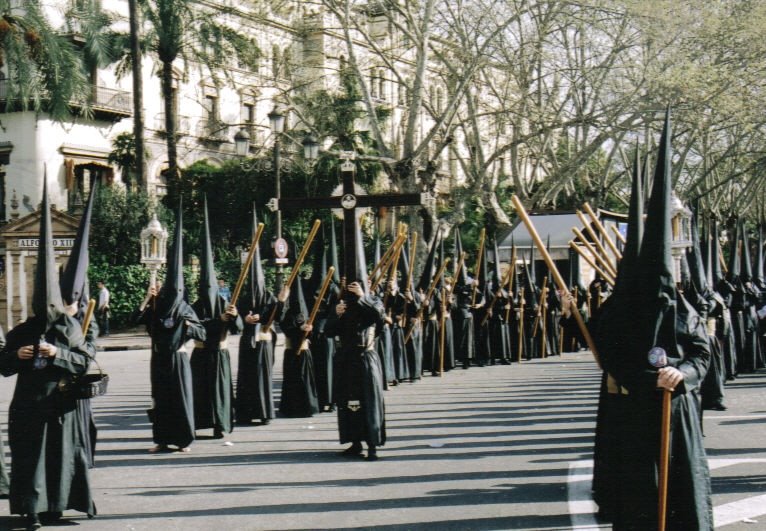
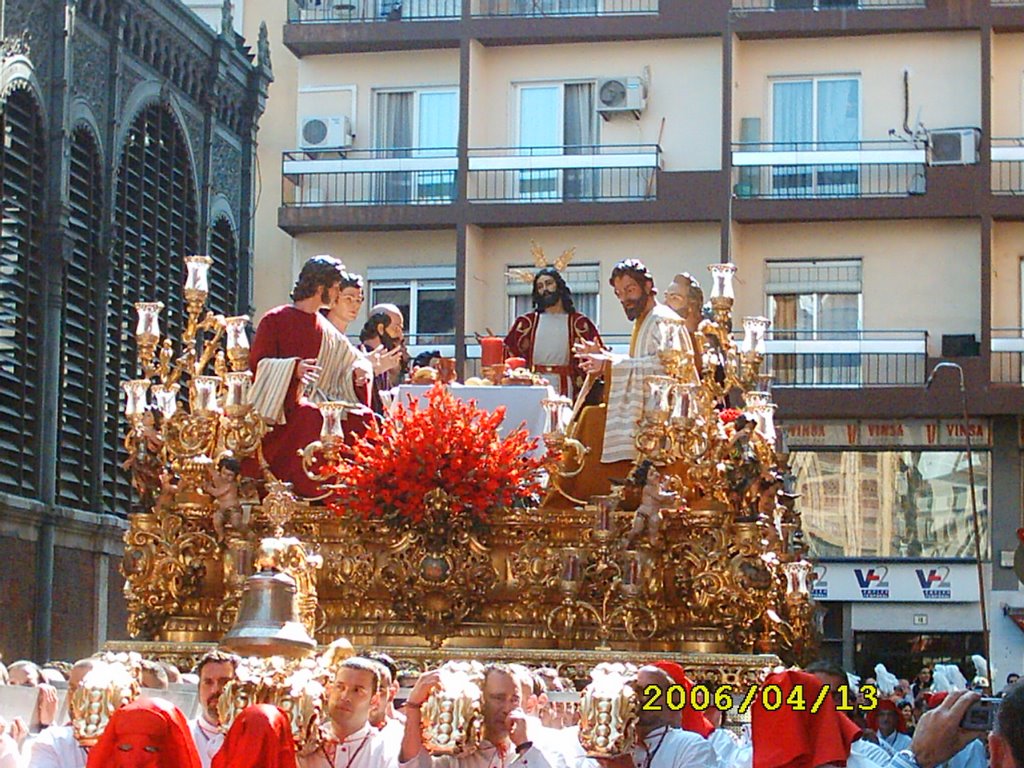
 In Spain, at least in the southern part which is the region of Andalusia, holy week is celebrated by the locals by holding about six processions a day from Palm to Easter Sunday. In big cities like Malaga and Sevilla, this tradition transforms the occasion into a major tourist magnet as people from all over Spain and from abroad head south just to witness this religious spectacle. Generally the processions are organized and participated in by church groups called cofradias or hermandades and center around the parading of a trono (float) that depicts a scene related to Christ's Passion. The tronos are really heavy. They are carried by about 25 men called costaleros who each have to carry a weight of 50 kilos and are followed by a long line of followers wearing ku-klux-klan costumes.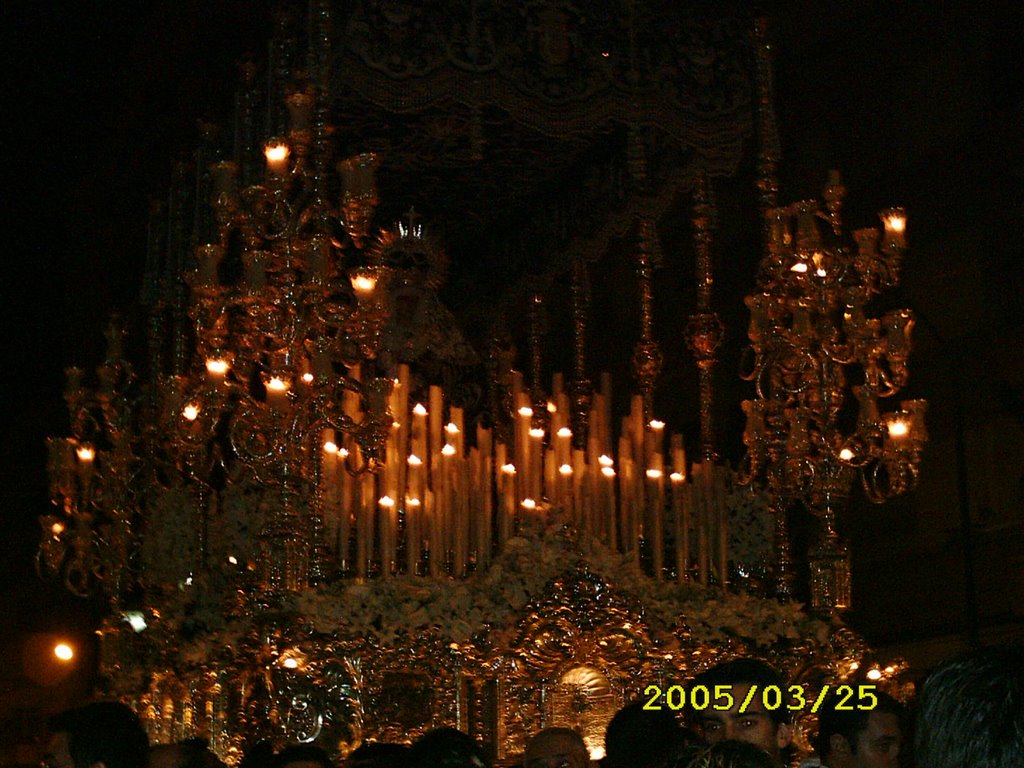
Here are some pictures from this and last year's holy week in Sevilla and Malaga (dated pictures borrowed from Jose Maria).


.jpg)



About Ampy (part 1)
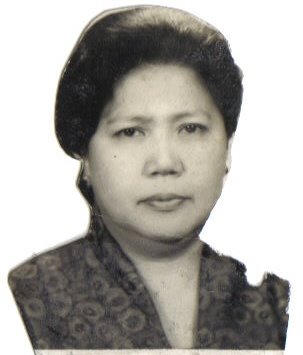 Last April 7 my relatives in Manila celebrated a very important occasion in our family. It was the 80th birthday of Ampy, an aunt of mine on the mother's side and our oldest living member. I thought I should write something about her in my blog because she is one of the major influences in my life.
When I was a child, I lived for six years in Ampy's house in Malate. My parents wanted to send me to St. Anthony School which was within walking distance from her place, so they transfered me there as soon as I finished prep. It was a huge house passed down by my grandparents to their children. For six years, I lived there with two other aunts, an uncle and her wife. My mom and I would stay in Malate from Monday to Friday and then go to Sta. Mesa to spend the weekend with my dad.
At that time (1985) I wished that Ampy were my real mother. I was very fond of her and I had reason to believe that I was her favorite. Still working then, she took me to children's parties and family activities at the office. I have plenty of memories of the Central Bank, where she used to work just like my dad and an uncle, including KFC in Harrison Plaza where she often treated me to a delicious meal. In the evening I would always wait impatiently for her to come home from work because she often brought home a surprise. No matter how unspecial it was, whatever she carried in her handbag was always a subject of competition between me and another aunt who was mentally challenged. Usually it was leftover sandwich, banana cake, chocolate cookies, empanada, fruits or whatever foodstuff the manang on her floor was selling.

Ampy had a masters in Public Administration and was the breadwinner of the family. She was administrative officer at the Central Bank and provided for two other aunts who were unmarried and unemployed, and for an uncle without a steady job for a long time. Since by then my lola had already died while my lolo lived with a second wife until his death in 1988, Ampy played the role of the family's matriarch.
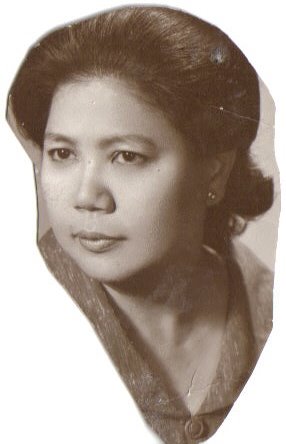
In the house, she kept an extended collection of stamps. In her room, she had several rows of shelves which she dedicated to a huge collection of Filipiniana dolls. Back then I didn't appreciate the sheer size of her collection but the dolls numbered about three hundred, excluding some which were constantly kept in plastic bags. Curious, I often played with these, messing up the dolls' arrangement in the shelves on the condition that I put them back one by one in place.
About Ampy (part 2)
Like my other aunts and the women of her generation, Ampy was a person of faith. More than anything, her world revolved around prayer groups, catechism and the bunch of equally religious men and women at St. Anthony Church whom she always called "sister" or "brother." Living in that house where religion was the norm (except for my uncle who was non-practicing) was no doubt one of the most exciting episodes in my childhood. I lived in a world of superstitions. One night, we suddenly even had to drive to a family friend's house to witness a esperitista session. The owners claimed that the house was being inhabited by evil spirits.
In Ampy's house, too, we often had bouts with the devil. Mentally challenged, my other aunt launched into cursing fits on certain nights. Sometimes, she would appear so enraged with almost blazing eyes and walk around the house murmuring frighteningly, that we thought her possessed by the devil. Sister Luring, one of Ampy's church friends, taught me a Latin prayer to use against evil spirits. It was salvum pactum iguritatis igosum, which she had lifted from a black, crumbling book and which I memorized by heart and muttered repeatedly from my room against the devil enslaving my aunt.
Ampy, for her part, taught me a technique to acquire the gift of tongues, or the proverbial miracle at Pentecost described in the Bible. During their house prayer meetings, her churchmates would close their eyes, pray aloud simultaneaously, sing and chant as if they spoke in different tongues. The technique was to produce the "la" sound repeatedly and with increasing speed until your summoning was heard and the holy spirit descended upon you. As an observer, I was fascinated by it no end. My life there was practically fantastic and supernatural. No wonder, my life ambition then was to become a priest and religion was my favorite subject in school.
Around the age of 8, I despised without effort my mom's being overprotective, so Ampy was the understanding and lenient alternate mom I had. She answered my questions about school work attentively, unlike dad who was rather impatient. Ampy never spanked me and she scolded me rather diplomatically. I felt extremely bad whenever she got mad, because it meant that my behavior had been truly unacceptable.
The few times that she did lose her patience happened while watching the televised Marcos electoral campaigns towards the end of 1985. My mother's family was from Ilocos Sur so Ampy was a die-hard loyalist. Growing up in a house full of Marcos t-shirts, pins, calendars and plastic fans, I was a young little loyalist myself. Whenever Marcos was shown on TV in his campaigns, I would shout at the top of my lungs "Marcos pa rin!!!" together with the huge throng of loyalists listening to his speech at the Quirino Grandstand. I would run amok in the living room, beat the sofa with throw pillows, roll on the floor and shout so loudly that the Cory fans in the neighborhood discovered our political clingings without difficulty. These outbursts were comparable to the cursing fits my mentally challenged aunt was capable of, that Ampy had no choice except to pin me down on the floor. In front of Marcos on TV, she would make me lie on my stomach and she would sit on my back like a cowboy on his horse. We would stay that way for about an hour in the living room until the campaign show ended and I was too exhausted to shout.
In Ampy's house, too, we often had bouts with the devil. Mentally challenged, my other aunt launched into cursing fits on certain nights. Sometimes, she would appear so enraged with almost blazing eyes and walk around the house murmuring frighteningly, that we thought her possessed by the devil. Sister Luring, one of Ampy's church friends, taught me a Latin prayer to use against evil spirits. It was salvum pactum iguritatis igosum, which she had lifted from a black, crumbling book and which I memorized by heart and muttered repeatedly from my room against the devil enslaving my aunt.
Ampy, for her part, taught me a technique to acquire the gift of tongues, or the proverbial miracle at Pentecost described in the Bible. During their house prayer meetings, her churchmates would close their eyes, pray aloud simultaneaously, sing and chant as if they spoke in different tongues. The technique was to produce the "la" sound repeatedly and with increasing speed until your summoning was heard and the holy spirit descended upon you. As an observer, I was fascinated by it no end. My life there was practically fantastic and supernatural. No wonder, my life ambition then was to become a priest and religion was my favorite subject in school.
Around the age of 8, I despised without effort my mom's being overprotective, so Ampy was the understanding and lenient alternate mom I had. She answered my questions about school work attentively, unlike dad who was rather impatient. Ampy never spanked me and she scolded me rather diplomatically. I felt extremely bad whenever she got mad, because it meant that my behavior had been truly unacceptable.
The few times that she did lose her patience happened while watching the televised Marcos electoral campaigns towards the end of 1985. My mother's family was from Ilocos Sur so Ampy was a die-hard loyalist. Growing up in a house full of Marcos t-shirts, pins, calendars and plastic fans, I was a young little loyalist myself. Whenever Marcos was shown on TV in his campaigns, I would shout at the top of my lungs "Marcos pa rin!!!" together with the huge throng of loyalists listening to his speech at the Quirino Grandstand. I would run amok in the living room, beat the sofa with throw pillows, roll on the floor and shout so loudly that the Cory fans in the neighborhood discovered our political clingings without difficulty. These outbursts were comparable to the cursing fits my mentally challenged aunt was capable of, that Ampy had no choice except to pin me down on the floor. In front of Marcos on TV, she would make me lie on my stomach and she would sit on my back like a cowboy on his horse. We would stay that way for about an hour in the living room until the campaign show ended and I was too exhausted to shout.
About Ampy (part 3)
Ampy in the middle (around 2004)
In the latter part of the 80s, Ampy reached retirement age and bought a piano and an electric organ with her end-of-service payment. They were meant for my mentally challenged aunt who played the piano like god, and for me who was learning it then. In 1991, when I transferred to LSM in high school and my mom and I moved back into my dad's house, Ampy asked me to take the electric organ so I could continue playing. I was hesitant knowing it was expensive and a major investment on her part, but she insisted. Unfortunately I didn't become half the piano player my mentally challenged aunt was.
In high school, we still frequented Ampy's house on some weekends and special occasions. Sometimes she and my relatives would visit us in Sta. Mesa. However, because of the distance, the contact became naturally less. I entered adolescence and became too tied to my world in the new school. In college, just like any adult, I became even busier that sometimes I tried to cut short our phone conversations.
As I was growing up, I failed to realize that Ampy was getting old. She used to seek my help in dyeing the hard-to-reach parts of her head but I didn't think of it much. I was too amused by the act of coloring her whitening hair. To me she was like any friend I had; I didn't even call her auntie or tita. I didn't realize our age gap until college, when I got frustrated because I couldn't take her to Enchanted Kingdom to ride the 360-degree roller coaster. As a teenager, I wanted to bring her too to clubs and discos but realized she was too old for that.
It came to a point that my fingers could count the number of times I'd been to Ampy's house in a given year. During one of my visits, I learned that her stamp collection was gone. She had also donated to some cause her beloved doll collection. Only my mom was enthusiastic enough to visit her sisters weekly while I was too busy with school and increasingly scarce in family occasions. Then one day I started getting wind that Ampy was having eye problems. Thru my mom, the news reached me in trickles. I would hear that Ampy visited the eye doctor frequently. I would hear that she had difficulty writing letters. I would hear that she had small accidents in the house bumping into the table or a chair. That one of her eyes had completely lost vision. Until one day I just heard that she finally ended up totally blind.
Or rather, good as totally blind. Because although one of her eyes can still see, the images are so fuzzy and bereft of light that she can't be on her own elsewhere but the house. Why that had to happen to her was beyond my understanding. It brought to pieces my concept of justice and fairness. The doctor said she was a case of glaucoma discovered too late. According to my mom, Ampy said she had been seeing fuzzy light for some time and thought it a form of divine apparition, which in reality was the symptoms of the disease. Given my mom's talent for animated storytelling, that version of the story must have been an exaggeration.
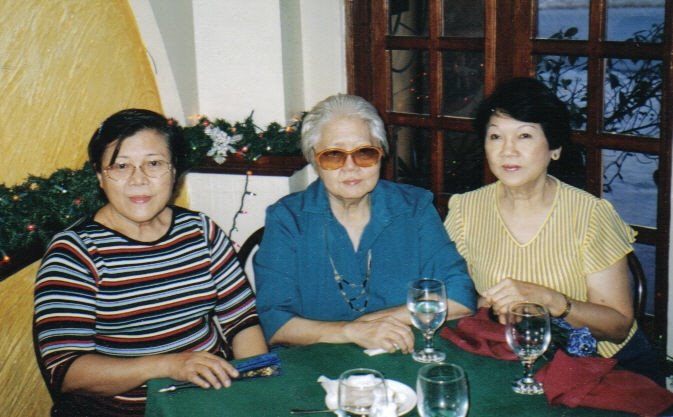
In the latter part of the 80s, Ampy reached retirement age and bought a piano and an electric organ with her end-of-service payment. They were meant for my mentally challenged aunt who played the piano like god, and for me who was learning it then. In 1991, when I transferred to LSM in high school and my mom and I moved back into my dad's house, Ampy asked me to take the electric organ so I could continue playing. I was hesitant knowing it was expensive and a major investment on her part, but she insisted. Unfortunately I didn't become half the piano player my mentally challenged aunt was.
In high school, we still frequented Ampy's house on some weekends and special occasions. Sometimes she and my relatives would visit us in Sta. Mesa. However, because of the distance, the contact became naturally less. I entered adolescence and became too tied to my world in the new school. In college, just like any adult, I became even busier that sometimes I tried to cut short our phone conversations.
As I was growing up, I failed to realize that Ampy was getting old. She used to seek my help in dyeing the hard-to-reach parts of her head but I didn't think of it much. I was too amused by the act of coloring her whitening hair. To me she was like any friend I had; I didn't even call her auntie or tita. I didn't realize our age gap until college, when I got frustrated because I couldn't take her to Enchanted Kingdom to ride the 360-degree roller coaster. As a teenager, I wanted to bring her too to clubs and discos but realized she was too old for that.
It came to a point that my fingers could count the number of times I'd been to Ampy's house in a given year. During one of my visits, I learned that her stamp collection was gone. She had also donated to some cause her beloved doll collection. Only my mom was enthusiastic enough to visit her sisters weekly while I was too busy with school and increasingly scarce in family occasions. Then one day I started getting wind that Ampy was having eye problems. Thru my mom, the news reached me in trickles. I would hear that Ampy visited the eye doctor frequently. I would hear that she had difficulty writing letters. I would hear that she had small accidents in the house bumping into the table or a chair. That one of her eyes had completely lost vision. Until one day I just heard that she finally ended up totally blind.
Or rather, good as totally blind. Because although one of her eyes can still see, the images are so fuzzy and bereft of light that she can't be on her own elsewhere but the house. Why that had to happen to her was beyond my understanding. It brought to pieces my concept of justice and fairness. The doctor said she was a case of glaucoma discovered too late. According to my mom, Ampy said she had been seeing fuzzy light for some time and thought it a form of divine apparition, which in reality was the symptoms of the disease. Given my mom's talent for animated storytelling, that version of the story must have been an exaggeration.
About Ampy (conclusion)
After graduating from UP and landing my first job, I began taking Ampy to dine out on special occasions, only to realize that I knew very little about her history. She was three times my age and had been alive long before my parents sent me to live in Malate. I did know a few basic things, though. That she had been married to a certain Brigidier, who had children by his first wife. In fact, I often answered the phone whenever Ludy, one of her step-daughters, gave a her call in Malate. That soon after their marriage Brigidier died and Ampy would never marry again. However, I knew nothing about the kind of life that she'd led with this family. How was she as a wife? As a mother? The only thing that reminded me that she had her own family was the letters delivered by the postman. They were addressed to Ampy "de Leon." My two other spinster aunts carried "Singson" as their surname.
So as much as possible, I converted our occacional lunch dates into interviews. I was interested in knowing the 70+ long years behind my aunt. She held the key not only to her history but to the history of my mom's family. The names of far-away relatives, stories about the old ancestral house in Cavite and in Kalye Remedios, of life during the war, were things I hadn't paid enough attention to as a young resident in our ancestral house for six years. Now that I was much older, I wanted Ampy to retell me these stories. Unfortunately and quite to my shame, I have made very little progress in this small project of mine.
To this day Ampy still writes letters to me while I prefer to call her occasionally given that writing snail mail is one of my greatest shortcomings. It's as if to prove with pride that the fuzzy vision of one of her eyes is still enough for her to write. I don't know how she does it but her penmanship seems exactly the same as that when her eyes were still functional. Also, on the phone, she doesn't sound like an 80-year-old woman. She's still as sharp as ever that sometimes I feel embarrassed when she catches me paying little attention.
She never fails to send something over to me thru my mom -- usually some vitamins, ointment for a body pain I'd complained to her about, or some gift which she fishes out from her cabinet of old stuff. She used to give me money when I was younger. Now, she doesn't earn any more money but still looks for something to give me from whatever belongings she has left in her old age.
One time, according to my mom, Ampy said I was like her own child. She does have step-children but since the death of her husband, the connection has diminished if not completely disappeared. She never bore her own child. On my part, I have this fear that she will pass away while I'm out of the Philippines, that one day I will get an emergency call from my mom that Ampy is gone. This fear is so great that sometimes I get paranoid and call home suddenly just to check on her. It is one fear that I hope will never materialize because I love her so much.
So as much as possible, I converted our occacional lunch dates into interviews. I was interested in knowing the 70+ long years behind my aunt. She held the key not only to her history but to the history of my mom's family. The names of far-away relatives, stories about the old ancestral house in Cavite and in Kalye Remedios, of life during the war, were things I hadn't paid enough attention to as a young resident in our ancestral house for six years. Now that I was much older, I wanted Ampy to retell me these stories. Unfortunately and quite to my shame, I have made very little progress in this small project of mine.
To this day Ampy still writes letters to me while I prefer to call her occasionally given that writing snail mail is one of my greatest shortcomings. It's as if to prove with pride that the fuzzy vision of one of her eyes is still enough for her to write. I don't know how she does it but her penmanship seems exactly the same as that when her eyes were still functional. Also, on the phone, she doesn't sound like an 80-year-old woman. She's still as sharp as ever that sometimes I feel embarrassed when she catches me paying little attention.
She never fails to send something over to me thru my mom -- usually some vitamins, ointment for a body pain I'd complained to her about, or some gift which she fishes out from her cabinet of old stuff. She used to give me money when I was younger. Now, she doesn't earn any more money but still looks for something to give me from whatever belongings she has left in her old age.
One time, according to my mom, Ampy said I was like her own child. She does have step-children but since the death of her husband, the connection has diminished if not completely disappeared. She never bore her own child. On my part, I have this fear that she will pass away while I'm out of the Philippines, that one day I will get an emergency call from my mom that Ampy is gone. This fear is so great that sometimes I get paranoid and call home suddenly just to check on her. It is one fear that I hope will never materialize because I love her so much.
jueves, abril 06, 2006
Ms. and Mr. España 2006
After fervently wishing for Manolo to leave me alone in the living room, I was able to catch the last few minutes of the show Mr. España last week. I was delighted to see a Malagueño grab the title from Mr. Madrid and Mr. Sevilla, and I felt even more pride upon learning two days later that Ms. España 2006 was also a native of the province where I live in Spain. This year's title-holders are both from Malaga, and what a coincidence it was! Well, at first I thought they weren't too exceptional, that this year's pool of candidates was low-quality, that they just happened to be more acceptable than the rest in that sea of ugly faces. I still believe that the winners from last year were much more stunning - Mr. Zaragoza (2nd runner-up) and Ms. Girona (Ms. España 2005). Lately though, it seems that these two Malagueños are slowly growing on me and I think that they're actually hot!

Juan Francisco García Postigo and Elisabeth Reyes




Juan Francisco García Postigo and Elisabeth Reyes



martes, marzo 28, 2006
Deadly odors
Goodbye winter! Hello spring! While in other parts of Spain this does not automatically translate to warm weather, in Malaga and in most coastal provinces in the south it does. There is no more use for thick and stylish winter coats. No more decorative mufflers. In the run-up to summer, fashion shifts toward plain shirts, rubber shoes, beach shorts, open-toed sandals. Temperatures are rising and because of that people sweat more. The transition from night to day can confuse somebody who's not from here. At 8 pm it's still possible to lie naked in the balcony and sunbathe. Yet there's hardly a trace of sunlight at 7:30 am.
Now, let me repeat something that I just said. People sweat more. Which is, actually, the sadness of it all. Riding the bus can never be so traumatizing as it is this time of the year. With the bus windows closed, it is possible to die from smelling sweaty armpits. It doesn't help to open the windows since the buses here have probably the narrowest windows on the planet. In fact, in case of a fire, not even a baby can escape through the windows, the only way to get out is to break them. Thus, in such an enclosed space, a suspicious odor can spread and propagate itself fast. Sitting beside a stinky old man in the bus, you are forced to choose between not breathing (the more hygienic option) and gasping for polluted armpit air. Both of these options are unfortunately deadly. You could either expire from lack of oxygen, or you could expose your bronchial tubes to serious damage and develop fatal lung problems in the long run.
Either way, the experience makes you realize that deodorant manufacturers aren't making that much money in Spain. It could even lead you to practice pyschology or attempt a bit of philosophizing: Why does this cretin seated beside me not use a roll-on? Perhaps something went terribly wrong in his childhood. Perhaps he was abused by the quirky ice cream vendor in the neighborhood...Is odor, like beauty, in the eyes of the beholder?
In winter, unlike in spring, everybody is fresh and clean-smelling. But as temperatures rise, the Spanish ability to wreak havoc on the health of your nostrils becomes a daily fact of life. Take for example one of my students. Lately it's become terrifying to teach him English for one and a half hours in his study room. He recently gave up wearing shoes in the house due to the changing of the seasons. Instead, he wears foamed slippers which are more comfortable in warm weather. The only problem is that he's got athlete's foot, and every time I'm with him I can almost see the stinking fumes rising from his feet and preparing to invade my poor nostrils.
The thing is, I can't even put up a fight. It's not polite to cover my nose all throughout the class!
Now, let me repeat something that I just said. People sweat more. Which is, actually, the sadness of it all. Riding the bus can never be so traumatizing as it is this time of the year. With the bus windows closed, it is possible to die from smelling sweaty armpits. It doesn't help to open the windows since the buses here have probably the narrowest windows on the planet. In fact, in case of a fire, not even a baby can escape through the windows, the only way to get out is to break them. Thus, in such an enclosed space, a suspicious odor can spread and propagate itself fast. Sitting beside a stinky old man in the bus, you are forced to choose between not breathing (the more hygienic option) and gasping for polluted armpit air. Both of these options are unfortunately deadly. You could either expire from lack of oxygen, or you could expose your bronchial tubes to serious damage and develop fatal lung problems in the long run.
Either way, the experience makes you realize that deodorant manufacturers aren't making that much money in Spain. It could even lead you to practice pyschology or attempt a bit of philosophizing: Why does this cretin seated beside me not use a roll-on? Perhaps something went terribly wrong in his childhood. Perhaps he was abused by the quirky ice cream vendor in the neighborhood...Is odor, like beauty, in the eyes of the beholder?
In winter, unlike in spring, everybody is fresh and clean-smelling. But as temperatures rise, the Spanish ability to wreak havoc on the health of your nostrils becomes a daily fact of life. Take for example one of my students. Lately it's become terrifying to teach him English for one and a half hours in his study room. He recently gave up wearing shoes in the house due to the changing of the seasons. Instead, he wears foamed slippers which are more comfortable in warm weather. The only problem is that he's got athlete's foot, and every time I'm with him I can almost see the stinking fumes rising from his feet and preparing to invade my poor nostrils.
The thing is, I can't even put up a fight. It's not polite to cover my nose all throughout the class!
viernes, marzo 17, 2006
Sick and alone
I'm sick. Spring has not yet officially set in which means it is still winter in Spain, but last Sunday it was so hot it felt like the worst days of summer. I took a walk outside the dorm under the sun's scorching heat and then I drank ice-cold beer as soon as I got back in the flat. That's how I started to cough, my throat got inflammed, etc.
Almost a week after it all started, I haven't fully recovered. Perhaps because I was foolish and stubborn and continued to smoke which irritated my throat some more. Right now my body hurts, my head aches and I chill at the wee hours of the morning. I barely sleep from too much coughing and I can't wait to stop blowing my nose.
At times like this I'm painfully reminded of the fact that I live far away from family. Just when I'm sick and there's no one to take care of me, I kind of give in to self-pity. That is perhaps my weak point because never do I succumb to self-pity unless I'm ill and I have to do the house chores myself. I pity myself because I'm feeling sick like hell and yet I have to cook for myself, wash the plates, do the laundry and go out to buy medicine.
Right now I'm thinking whether I should use my medical insurance and check in at a hospital. At least there somebody would bring me food, medicine and everything would be comfy. But if I don't recover over the weekend, the doctors might decide to keep me. That is not good since I have important things to do next week.
Hmmmm...
Almost a week after it all started, I haven't fully recovered. Perhaps because I was foolish and stubborn and continued to smoke which irritated my throat some more. Right now my body hurts, my head aches and I chill at the wee hours of the morning. I barely sleep from too much coughing and I can't wait to stop blowing my nose.
At times like this I'm painfully reminded of the fact that I live far away from family. Just when I'm sick and there's no one to take care of me, I kind of give in to self-pity. That is perhaps my weak point because never do I succumb to self-pity unless I'm ill and I have to do the house chores myself. I pity myself because I'm feeling sick like hell and yet I have to cook for myself, wash the plates, do the laundry and go out to buy medicine.
Right now I'm thinking whether I should use my medical insurance and check in at a hospital. At least there somebody would bring me food, medicine and everything would be comfy. But if I don't recover over the weekend, the doctors might decide to keep me. That is not good since I have important things to do next week.
Hmmmm...
lunes, febrero 27, 2006
Galicia, a timely distraction
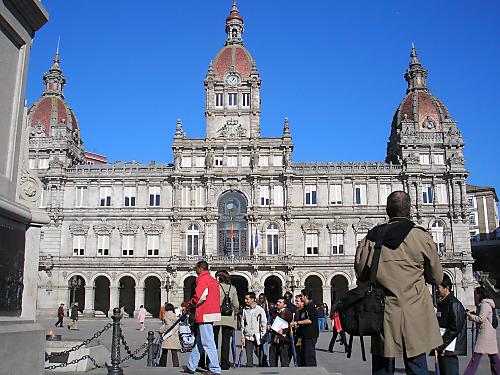
 A couple of weeks ago I hopped on a bus at 12 midnight to join a free trip sponsored by AECI for its scholars. I was somewhat hesitating at first to sign up for it since I would need to take some six precious days off my thesis calendar (feb. 8-12). That was a decision that my heart was not prepared to make, but then again the destination was tempting enough to make me realize that hey, it's my chance. So off I went to Galicia. A Spanish region in the north facing the Atlantic Ocean and set apart from Malaga by some 16 butt-numbing hours of road travel. I'd never been to that part of Spain before, so it's a good thing I grabbed the chance!
Although slots had been limited, it turned out that the size of the group was sheer, big enough to make the locals think that we were either a bunch of college kids on excursion or a busload of Japanese tourists ready to attack with our cameras at the first sight of a fountain. All in all some 150 graduate students coming from different cities in Spain got together for the event, the majority of whom were Africans and Latin Americans. The group was so big it was impossible to get to know everyone.
We spent most of the time in Sada and A Coruña but for me the real highlight of the trip was Santiago de Compostela, famous more than anything for El Camino de Santiago, which is a pilgrimage to the city's cathedral braved every year by thousands of tourists who come on foot from as far as the Netherlands. Given how lovely this UNESCO-protected city is, I might just be crazy enough one day to do the camino, which according to former pilgrims requires typically 30 days of walking!
Every corner you turn to in the old quarter of Santiago de Compostela seems to be a discovery in itself. There's always something that will fascinate you for a while: an old building, a plaza, a home-made food shop, an old-style house, a bench in the park, and yes, some nice fountains. It was nice to get lost in the narrow streets of the old quarter. Most of the old houses and buildings are well-preserved that it is possible to see the natural stone color of their facades.
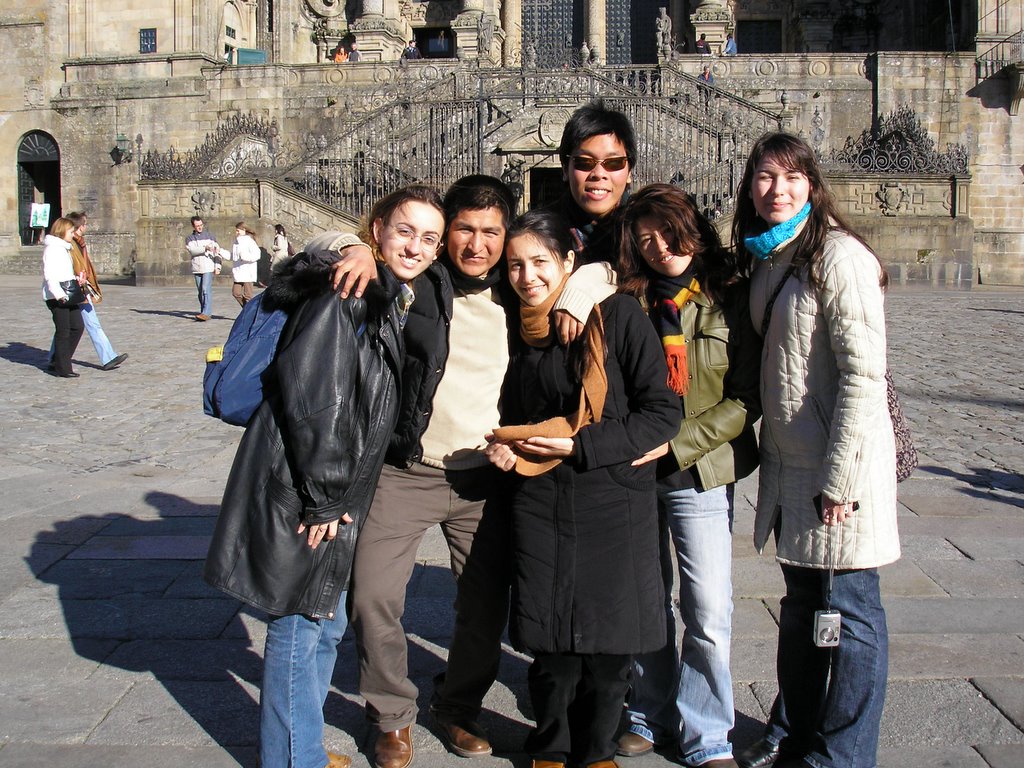
During the trip, I found some really fun-loving buddies although most of the time I was drifting from one group to another. In Santiago de Compostela, and even in Sada, we often hanged out in cafes to have a taste of the local fare. The ones that really tickled my taste buds were pulpo a la gallega (octopus cuts in olive oil and paprika) and pan gallego (the local bread). Though I didn't intend to spend too much while on a free trip, I dished out a few bucks to bring home some vino de ribeiro (a regional wine, cheap but really nice) and la tarta de santiago (a local almond cake), for which I would perhaps be willing to kill just to be able to buy them again (they're not sold in Malaga!).
On the second to the last day, we missed the chartered bus that was supposed to take us back to the hotel at night, we decided to have some drinks at a bar. The place was still empty when we arrived so we had the whole bar to ourselves. Slightly inebriated, my fun-loving buddies had the bright idea of taking some "compromising" pictures with their digicams. Too bad most of these fun-loving buddies were women (sigh...). After posing for some "wild" shots, the Russian girl left our table to work up a conversation with the "handsome" waiter stationed at the bar. In the end, she earned the waiter's email address.
After the trip, AECI sent an evaluation survey by email to all the participants of the event. By the way, aside from sightseeing, the trip included a dialogue with an AECI official regarding problems with scholarship rules and a really short group discussion on international cooperation, multi-culturalism and the spirit of volunteerism. To be honest, my thesis-pulverized brain could not exactly decipher the purpose of that event except that we were pampered to our heart's desire and billeted in posh hotels. Because of that, I have purposely put off sending back the evaluation survey, lest I would be forced to tell them that the event seemed quite pointless. After all...I'd like them to pamper again the scholars next year!
Suscribirse a:
Entradas (Atom)